


LATEST ARTICLE
Older
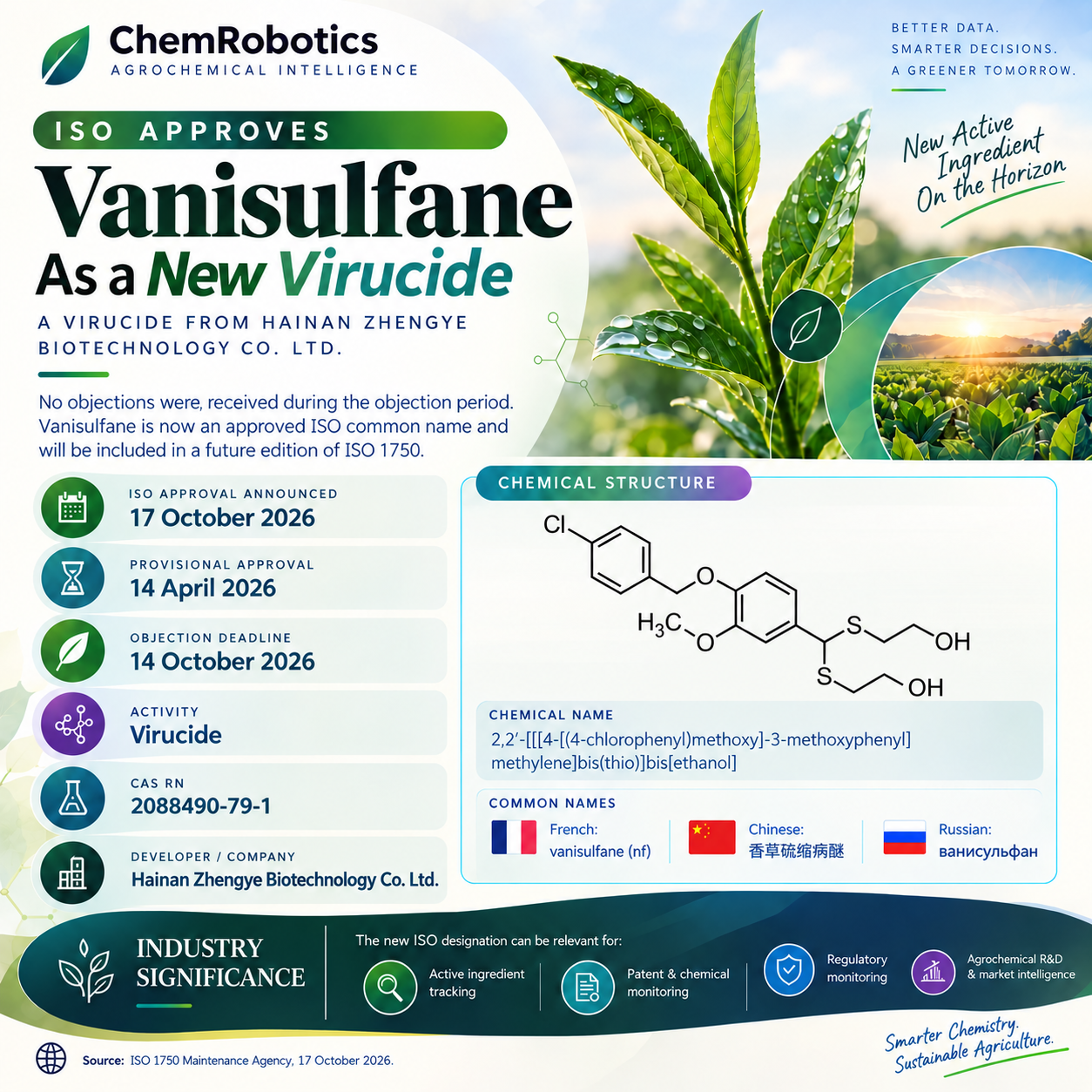
ISO Approves Vanisulfane: A New Virucide Common Name from Hainan Zhengye
On 17 October 2026, the ISO 1750 Maintenance Agency announced that vanisulfane has become an approved ISO common name for a virucide from Hainan Zhengye Biotechnology Co. Ltd. The name was provisionally approved on 14 April 2026. With no objections received by the end of the six-month objection period, vanisulfane is now approved and will be included in a future edition of ISO 1750. Abstract The ISO 1750 Maintenance Agency has approved vanisulfane as the common name for a virucide developed by Hainan Zhengye Biotechnology Co. Ltd. The compound is identified by CAS RN 2088490-79-1 and has the chemical name: 2,2′-[[[4-[(4-chlorophenyl)methoxy]-3-methoxyphenyl]methylene]bis(thio)]bis[ethanol] No objections were received during the objection period, so the name has become approved. It will be included in a new edition of ISO 1750, which will include preferred names as well as common names.

Cinflubrolin Gets a Sharper Definition: Isomer Mix Moves from 50/50 to 85/15, Less Than a Year After ISO Debut
The ISO 1750 Maintenance Agency has updated the isomeric composition of Cinflubrolin at the request of its sponsor, Qingdao KingAgroot Chemical Compound Co., Ltd. The new definition is a mixture of 85-100% (1S,2R,4R)-isomer and 15-0% (1R,2S,4S)-isomer. The December 2025 definition specified at least 50% of the (1S,2R,4R)-isomer alongside 50% of the (1R,2S,4S)-isomer, effectively a near-even mix. The revision makes the (1S,2R,4R)-isomer the clear major component and allows a single-isomer product to qualify.

The Next Generation of Herbicides: New Modes of Action and Emerging Herbicide Molecules
The herbicide industry is entering a new phase of innovation as increasing weed resistance creates demand for new chemical structures, improved selectivity and better resistance-management solutions. The 2026 HRAC classification added five active ingredients—metproxybicyclone, dimesulfazet, icafolin-methyl, iptriazopyrid and rimisoxafen—highlighting continued development across several herbicide modes of action. The article examines emerging herbicide chemistry including metproxybicyclone, an ACCase inhibitor; dimesulfazet, a VLCFA-biosynthesis inhibitor for rice; and other emerging molecules such as iptriazopyrid, bipyribicyclone and prosulfopyzone. It emphasizes that a “next-generation” herbicide does not necessarily require a completely new biological target—new chemical architectures, improved selectivity and effectiveness against resistant weeds can also provide significant innovation. A key focus is the growing importance of herbicide-resistance management, including target-site and non-target-site resistance, and the need to combine new chemistry with herbicide rotation, mixtures and integrated weed-management practices. The article also highlights how AI, patent intelligence, technical-route data, regulatory intelligence and chemical databases can help companies identify promising herbicide opportunities earlier in the development cycle. In short: the future of herbicide innovation will be driven by the combination of new chemistry + resistance management + crop selectivity + advanced scientific intelligence, creating opportunities for agrochemical R&D, generic manufacturers, CDMOs, CROs and specialty-chemical companies.

ISO Approves New Name: Prosulfopyzone Emerges as a Novel Benzoylpyrazole Herbicide
On September 25, 2026, the ISO 1750 Maintenance Agency provisionally approved prosulfopyzone as a new ISO common name for a benzoylpyrazole herbicide from Liaoning Cynda Chemical Co. Ltd. The provisional approval establishes “prosulfopyzone” as the proposed ISO common name for this new herbicidal active ingredient, subject to the completion of the objection period. Abstract The ISO 1750 Maintenance Agency has provisionally approved prosulfopyzone as a new ISO common name for a benzoylpyrazole herbicide from Liaoning Cynda Chemical Co. Ltd. The common name was provisionally approved on 25 September 2026. The compound is identified by CAS RN 3121509-99-4 and has the chemical name: 4-[2-chloro-4-(methylsulfonyl)-3-[(propylsulfonyl)methyl]benzoyl]-1,3-dimethyl-1H-pyrazol-5-yl N,N-diethylcarbamate Objections to the proposed name may be submitted to the ISO 1750 Maintenance Agency until 25 March 2027. If no valid objections are received during the specified period, prosulfopyzone will become an approved ISO common name and will be included in a future edition of ISO 1750.

Agrochemical Discovery Update 2026: ISO Updates the Principles for Selecting Pesticide Common Names
The International Organization for Standardization (ISO) has updated its guidance on the selection of common names for pesticides and other agrochemicals, providing a structured framework for the identification and international recognition of new active ingredients. The updated guidance addresses key aspects of common-name selection, including chemical identity, structural relationships, distinctiveness, pronunciation, potential conflicts with existing pesticide and pharmaceutical names, and trademark considerations. The ISO 1750 system further connects common names with important chemical identifiers such as CAS Registry Numbers, systematic names, molecular structures, InChI and InChIKey. This article examines the significance of the updated ISO framework for agrochemical research and development, regulatory affairs, intellectual property, competitive intelligence and CDMO activities. It also discusses the ISO common-name approval process, including proposal, technical examination, provisional approval, objection period and final inclusion in the ISO 1750 dataset. By linking development codes, chemical structures, CAS RNs, patents, ISO common names and regulatory information, organizations can build a more integrated approach to monitoring emerging agrochemical active ingredients and identifying future technology and manufacturing opportunities.
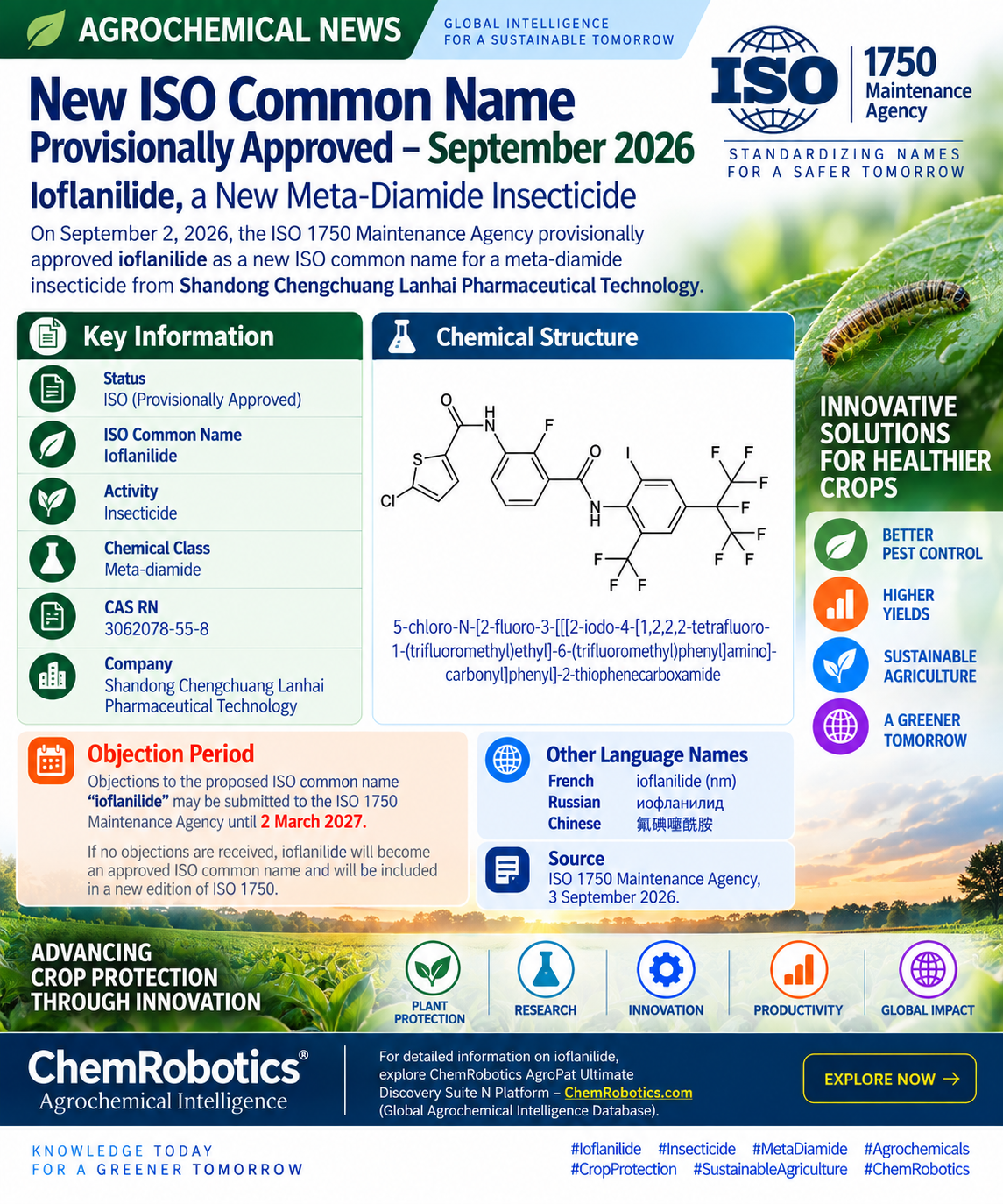
New ISO Common Name Provisionally Approved – September 2026: Ioflanilide, a New Meta-Diamide Insecticide
On September 2, 2026, the ISO 1750 Maintenance Agency provisionally approved ioflanilide as a new ISO common name for a meta-diamide insecticide developed by Shandong Chengchuang Lanhai Pharmaceutical Technology. The provisional approval represents an important nomenclature milestone for this new insecticidal active ingredient, establishing “ioflanilide” as its proposed ISO common name, subject to completion of the objection period. Abstract The ISO 1750 Maintenance Agency has provisionally approved ioflanilide as a new ISO common name for a meta-diamide insecticide from Shandong Chengchuang Lanhai Pharmaceutical Technology. The common name was provisionally approved on 2 September 2026. The compound is identified by CAS RN 3062078-55-8 and has the chemical name: 5-chloro-N-[2-fluoro-3-[[[2-iodo-4-[1,2,2,2-tetrafluoro-1-(trifluoromethyl)ethyl]-6-(trifluoromethyl)phenyl]amino]carbonyl]phenyl]-2-thiophenecarboxamide The proposed name ioflanilide is currently subject to an objection period ending on 2 March 2027.
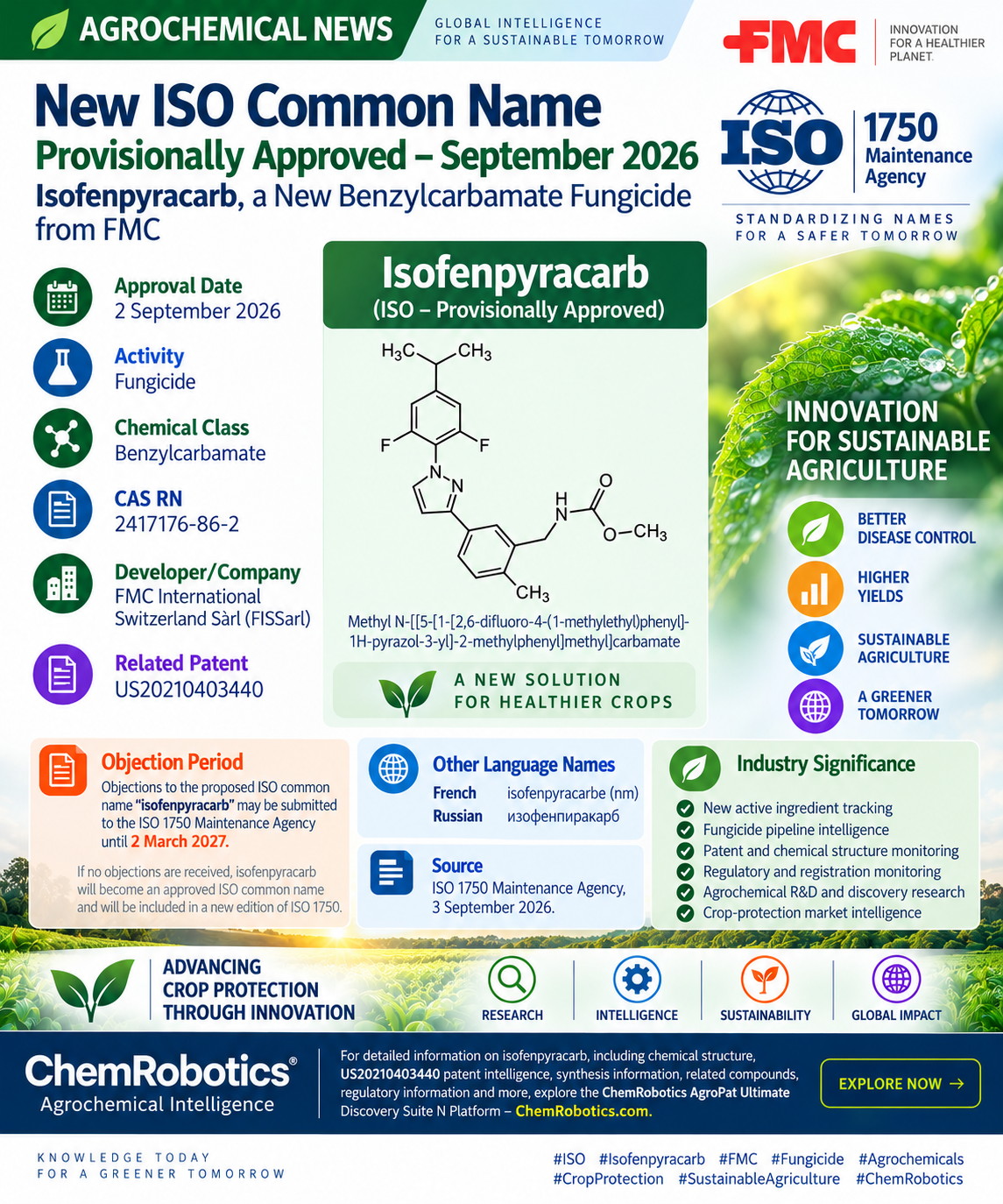
New ISO Common Name Provisionally Approved – September 2026: Isofenpyracarb, a New Benzylcarbamate Fungicide from FMC
On September 2, 2026, the ISO 1750 Maintenance Agency provisionally approved isofenpyracarb as a new ISO common name for a benzylcarbamate fungicide developed by FMC International Switzerland Sàrl (FISSarl). The provisional approval represents an important nomenclature milestone for this new fungicidal active ingredient, establishing “isofenpyracarb” as its proposed ISO common name, subject to the completion of the objection period. Abstract The ISO 1750 Maintenance Agency has provisionally approved isofenpyracarb as a new ISO common name for a benzylcarbamate fungicide from FMC International Switzerland Sàrl (FISSarl). The common name was provisionally approved on 2 September 2026. The compound is identified by CAS RN 2417176-86-2 and has the chemical name: Methyl N-[[5-[1-[2,6-difluoro-4-(1-methylethyl)phenyl]-1H-pyrazol-3-yl]-2-methylphenyl]methyl]carbamate Objections to the proposed name may be submitted to the ISO 1750 Maintenance Agency until 2 March 2027. If no objections are received during the specified period, isofenpyracarb will become an approved ISO common name and will be included in a future edition of ISO 1750.
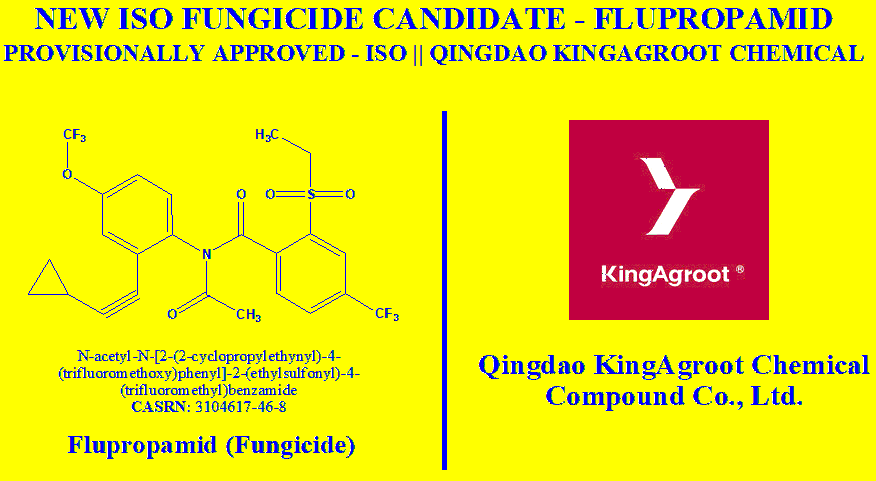
ISO Provisionally Approves New Fungicide Common Name Flupropamid
August 24, 2026 — ISO: The ISO 1750 Maintenance Agency has announced the provisional approval of “flupropamid” as a new common name for a fungicide from Qingdao KingAgroot Chemical Compound Co., Ltd. The new common name flupropamid was provisionally approved on August 22, 2026. The corresponding Chinese common name is 氟炔菌酰胺. Flupropamid has been provisionally approved as a new ISO 1750 fungicide common name. Objections, including potential trademark conflicts, may be submitted by February 22, 2027. If no objections are received, the name will become an approved ISO common name and be included in the next edition of ISO 1750.
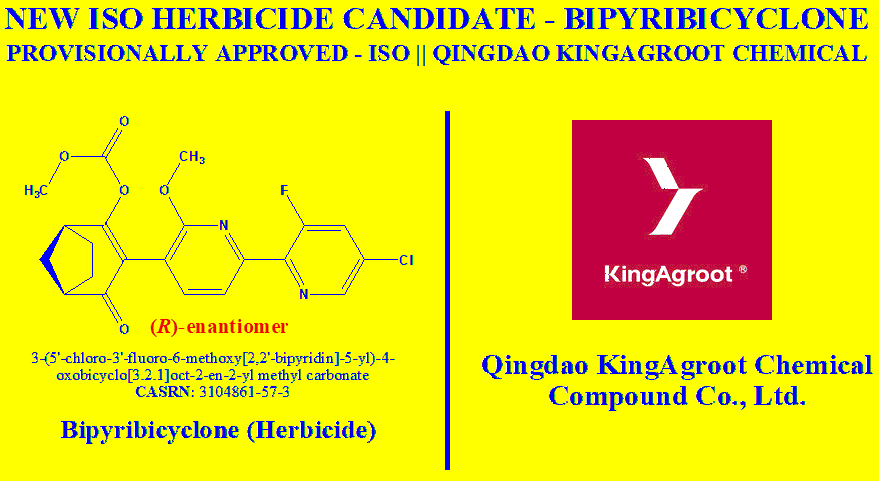
New ISO Name Provisionally Approved – August 2026: Bipyribicyclone, A New Herbicide Compound from Qingdao KingAgroot Chemical Compound Co., Ltd.
On August 22, 2026, ISO provisionally approved Bipyribicyclone as the common name for a new herbicide compound from Qingdao KingAgroot Chemical Compound Co. Bipyribicyclone is a new herbicide compound for which a common name has been provisionally approved by the ISO 1750 Maintenance Agency. The provisional approval represents an important nomenclature milestone for the compound, establishing “bipyribicyclone” as its proposed ISO common name pending completion of the objection period. Abstract The ISO 1750 Maintenance Agency has provisionally approved bipyribicyclone as a new ISO common name for a herbicide from Qingdao KingAgroot Chemical Compound Co., Ltd. The common name was provisionally approved on 22 August 2026. The compound, identified by CAS RN 3104861-57-3, has the Chinese common name 氯氟啶草酯. Objections to the proposed name may be submitted to the ISO 1750 Maintenance Agency until 22 February 2027. If no objections are received, bipyribicyclone will become an approved ISO common name and will be included in a new edition of ISO 1750.
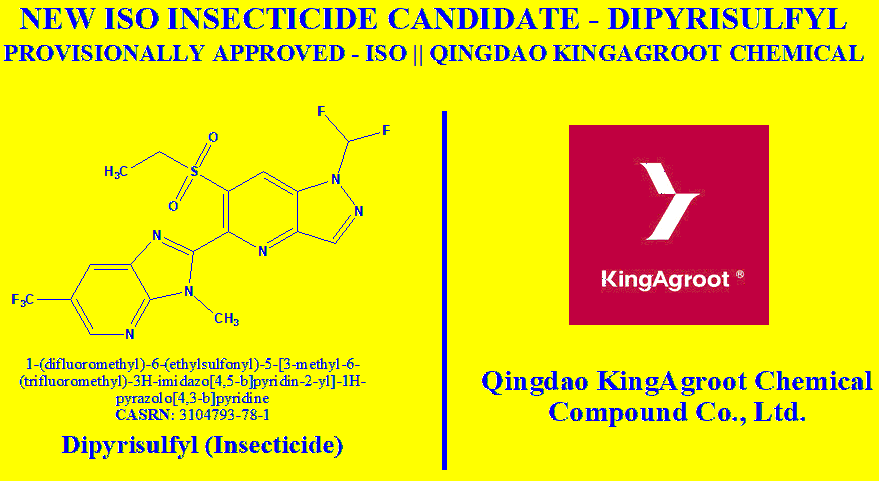
Qingdao KingAgroot’s Dipyrisulfyl Receives Provisional ISO Common Name
August 24, 2026 — International: The ISO 1750 Maintenance Agency has provisionally approved the new common name dipyrisulfyl for a novel insecticide developed by Qingdao KingAgroot Chemical Compound Co., Ltd. The corresponding Chinese common name is 砜虫啶. The common name was provisionally approved on August 22, 2026, representing an important nomenclature milestone for the newly developed active ingredient. Chemical Identity The ISO-listed chemical name of dipyrisulfyl is: 1-(difluoromethyl)-6-(ethylsulfonyl)-5-[3-methyl-6-(trifluoromethyl)-3H-imidazo[4,5-b]pyridin-2-yl]-1H-pyrazolo[4,3-b]pyridine CAS Registry Number: 3104793-78-1 Provisional Status and Objection Period The name dipyrisulfyl is currently under provisional approval. An objection period has been established by the ISO 1750 Maintenance Agency, extending until February 22, 2027. During this period, objections may be submitted, including on grounds such as potential conflict with an existing company trademark or other relevant concerns. If no valid objections are received within the specified period, dipyrisulfyl is expected to progress to an approved ISO common name and be included in a future edition of ISO 1750, which covers approved common names and preferred names for pesticides

The Next Big Opportunity in Agrochemicals May Not Be the Active Ingredient — It May Be the Intermediate
The global agrochemical industry is entering a new phase of innovation characterized by increasingly complex molecular structures, growing use of fluorinated chemistry, advanced heterocyclic building blocks, and the emergence of new crop-protection active ingredients. These developments are creating new opportunities for manufacturers of agrochemical intermediates, specialty chemicals, and CDMO/CRAMS organizations. This article examines the strategic opportunity landscape for agrochemical intermediates during 2026–2030, focusing on chemistry platforms such as fluorinated pyridines, fluorinated pyrazoles, CF₃-anilines, fluorinated benzoic acids, advanced benzoyl derivatives, fluoropyrimidines, meta-diamide building blocks, and isoxazoline-related intermediates. It highlights how new active-ingredient pipelines, patent activity, downstream applications, supplier concentration, technical complexity, import dependence, and manufacturing feasibility can be used to identify future high-potential intermediate opportunities. Rather than focusing only on current market demand, the article presents a forward-looking approach to identifying what manufacturers may need to develop, manufacture, source, or commercialize next. This perspective is particularly relevant for agrochemical technical manufacturers, intermediate producers, CDMO/CRAMS companies, specialty chemical manufacturers, and organizations seeking opportunities in import substitution and strategic chemical manufacturing. The analysis suggests that the competitive advantage of the future may increasingly depend not only on manufacturing capability, but also on the ability to identify emerging chemical opportunities early and convert scientific intelligence into commercially actionable decisions.
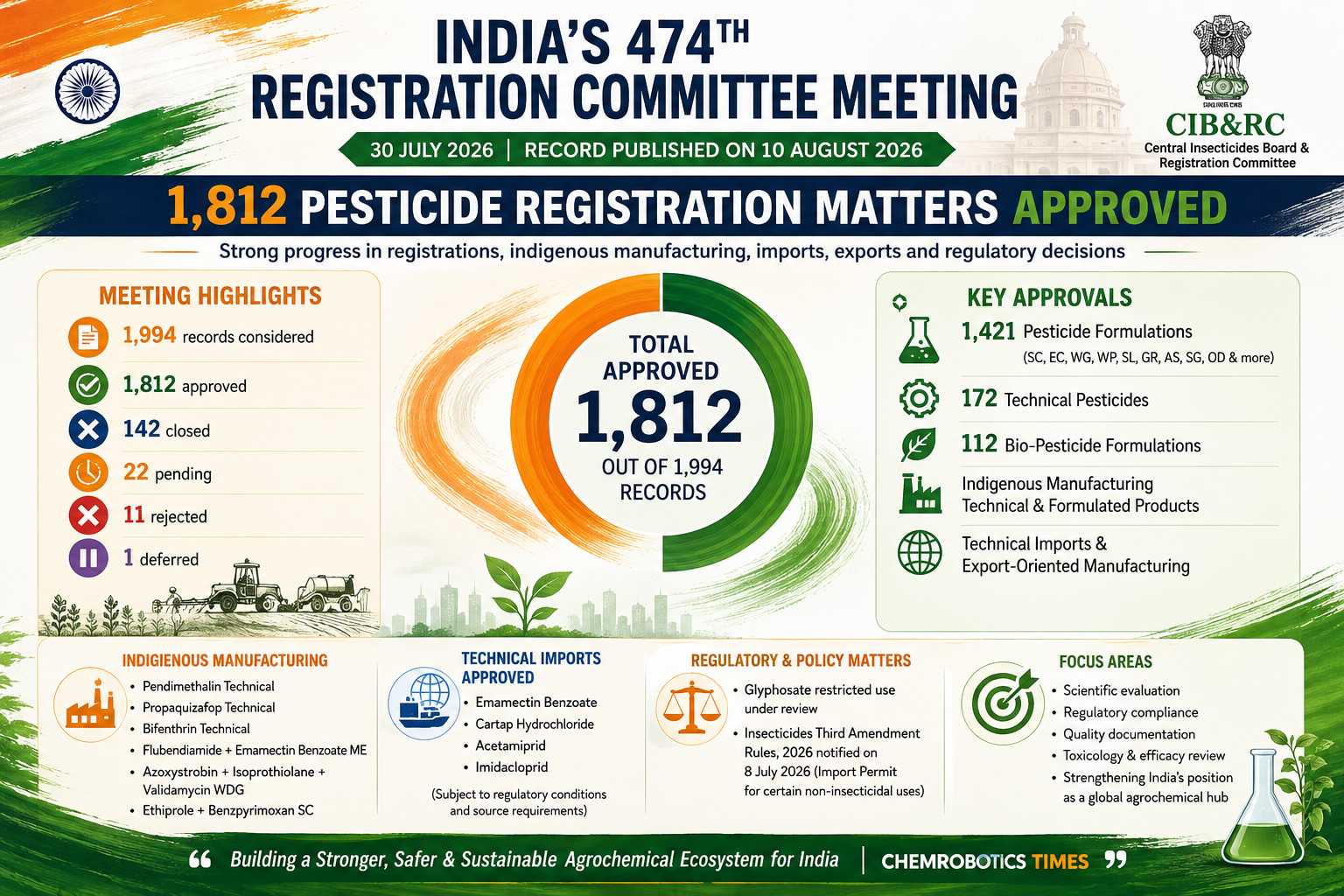
India’s 474th Registration Committee Meeting Clears 1,812 Pesticide Registration Matters
Abstract The Central Insecticides Board & Registration Committee (CIB&RC), in its 474th Registration Committee (RC) meeting held on 30 July 2026, considered a broad range of pesticide registration, manufacturing, import, formulation, export and regulatory matters. The meeting record, published on 10 August 2026, contains 1,994 agenda records, of which 1,812 were recorded as approved. The decisions cover conventional pesticide formulations, technical-grade active ingredients, bio-pesticides, indigenous manufacturing, technical imports, export-only manufacturing and several important regulatory issues affecting the Indian agrochemical industry.

Sumitomo Chemical Submits Registration Applications for New Fungicide Bifemetstrobin
July 9, 2026 — Japan: Sumitomo Chemical has submitted registration applications for its new fungicide bifemetstrobin (ISO common name) to regulatory authorities in Japan, the United States, and Brazil. Bifemetstrobin is a novel fungicide active ingredient discovered by Sumitomo Chemical and belongs to the quinone outside inhibitor (QoI) / strobilurin group. Bifemetstrobin is described as a novel, broad-spectrum strobilurin fungicide with contact action. Its mode of action is based on inhibition of the energy production process in pathogenic fungi, with PPDB classifying it as a mitochondrial respiration inhibitor and assigning it to FRAC Group 22. According to Sumitomo Chemical, internal and external evaluations have confirmed that bifemetstrobin demonstrates high efficacy against strains resistant to existing QoI fungicides. The compound has also shown efficacy against soybean rust, a disease prevalent in Brazil and other regions, making it a potential new tool for fungicide-resistance management and crop protection.

Corteva Launches New Herbicide Enclosa™ for U.S. Soybean Farmers
04 August 2026 | Indianapolis, USA: Corteva has announced the launch of Enclosa™ herbicide, a new soybean weed management solution designed to provide flexible control of broadleaf weeds and grasses across diverse production systems. The herbicide has received approval from the U.S. Environmental Protection Agency (EPA) and is currently undergoing state-level registration processes ahead of commercial availability. Enclosa™ combines Corteva's proprietary encapsulated acetochlor (HRAC Group 15) with cloransulam (HRAC Group 2) in a single premix formulation. According to the company, the combination provides residual weed control for up to four weeks while delivering both residual and systemic activity against more than 36 broadleaf weed and grass species in pre- and post-emergence soybean applications. Drake Robards, Portfolio Marketing Lead for Soybean Herbicides at Corteva, said the launch reflects the company's continued investment in soybean herbicide innovation. He noted that Enclosa™ expands Corteva's herbicide portfolio by offering growers another flexible weed management option designed to support yield potential and simplify management decisions.
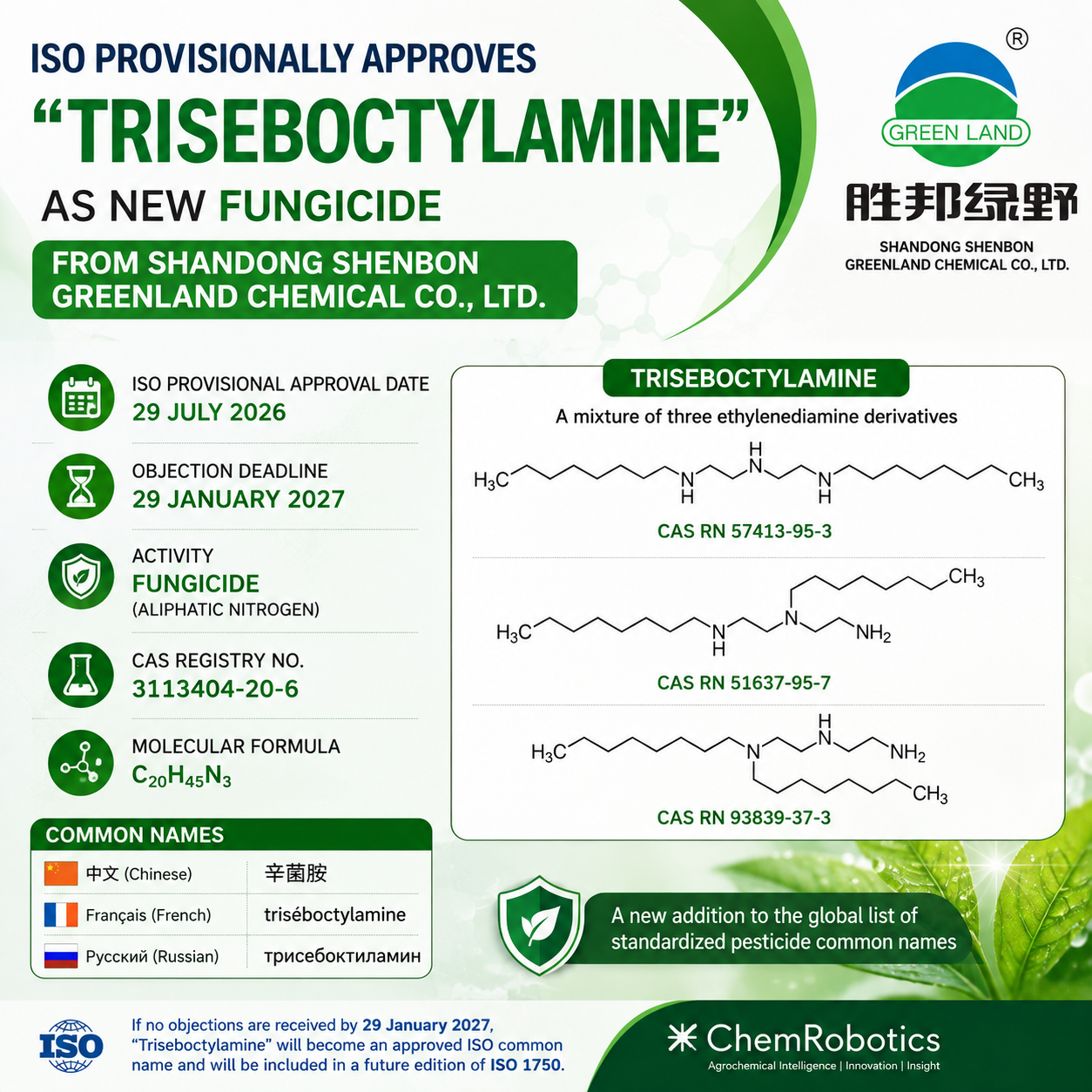
ISO Provisionally Approves “Triseboctylamine” as New Common Name for Fungicide from Shandong Shenbon Greenland Chemical
The ISO Common Names Maintenance Agency has provisionally approved "triseboctylamine" as the ISO common name for a new aliphatic nitrogen fungicide developed by Shandong Shenbon Greenland Chemical Co., Ltd. The provisional approval was granted on 29 July 2026, with the Chinese common name 辛菌胺. Unless objections are submitted by 29 January 2027, the name will become an officially approved ISO common name and will be incorporated into a future edition of ISO 1750. Triseboctylamine represents a multi-component amine fungicide mixture designed for plant disease management and is also associated with derivative compounds such as triseboctylamine acetate.
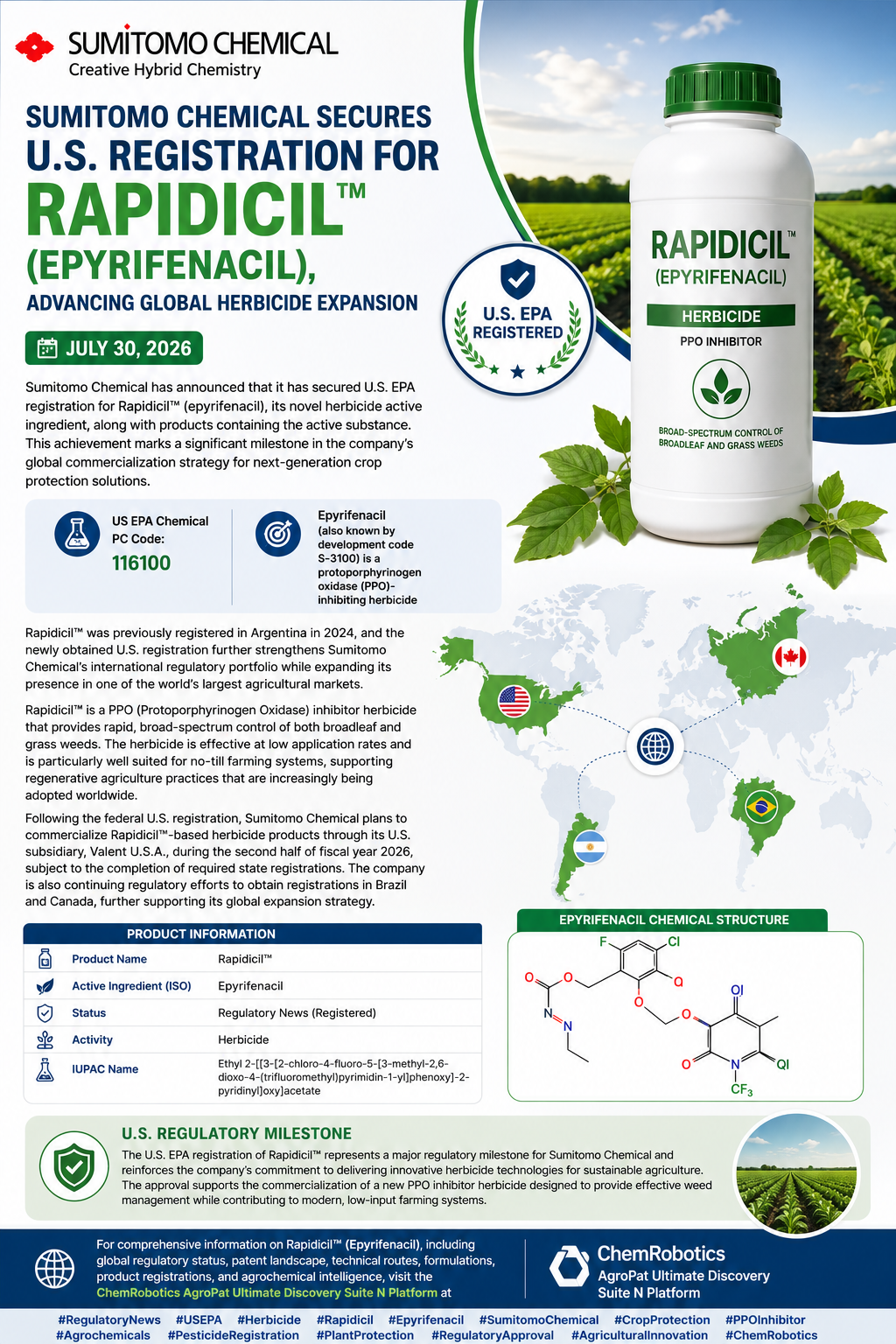
Sumitomo Chemical Secures U.S. Registration for Rapidicil™ (Epyrifenacil), Advancing Global Herbicide Expansion
July 30, 2026 Sumitomo Chemical has announced that it has secured U.S. EPA registration for Rapidicil™ (epyrifenacil), its novel herbicide active ingredient, along with products containing the active substance. This achievement marks a significant milestone in the company's global commercialization strategy for next-generation crop protection solutions. The US EPA chemical PC code for epyrifenacil is 116100. Epyrifenacil (also known by development code S-3100) is a protoporphyrinogen oxidase (PPO)-inhibiting herbicide Rapidicil™ was previously registered in Argentina in 2024, and the newly obtained U.S. registration further strengthens Sumitomo Chemical's international regulatory portfolio while expanding its presence in one of the world's largest agricultural markets. Rapidicil™ is a PPO (Protoporphyrinogen Oxidase) inhibitor herbicide that provides rapid, broad-spectrum control of both broadleaf and grass weeds. The herbicide is effective at low application rates and is particularly well suited for no-till farming systems, supporting regenerative agriculture practices that are increasingly being adopted worldwide. Following the federal U.S. registration, Sumitomo Chemical plans to commercialize Rapidicil™-based herbicide products through its U.S. subsidiary, Valent U.S.A., during the second half of fiscal year 2026, subject to the completion of required state registrations. The company is also continuing regulatory efforts to obtain registrations in Brazil and Canada, further supporting its global expansion strategy.
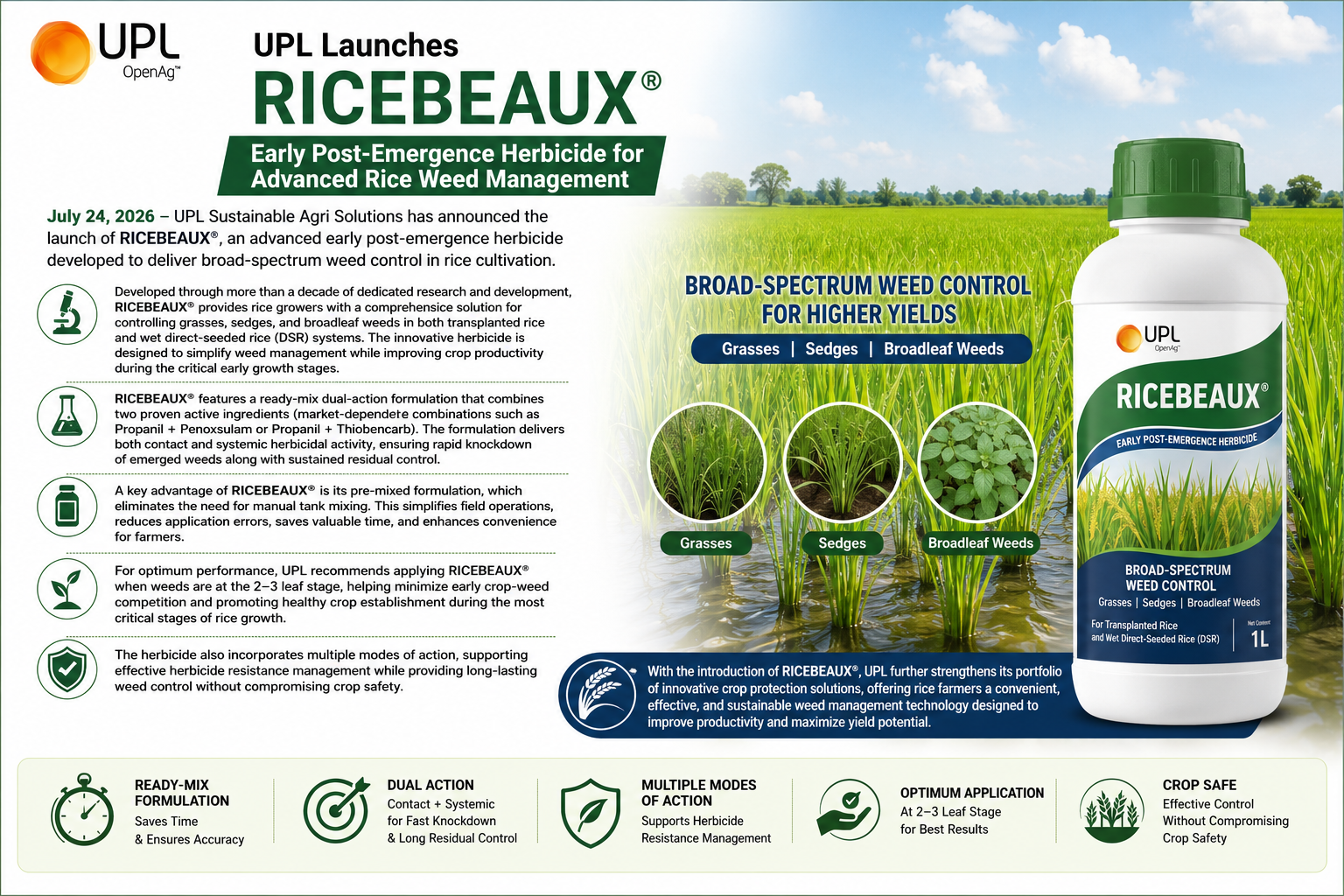
UPL Launches RICEBEAUX® Early Post-Emergence Herbicide for Advanced Rice Weed Management
July 24, 2026 – UPL Sustainable Agri Solutions has announced the launch of RICEBEAUX®, an advanced early post-emergence herbicide developed to deliver broad-spectrum weed control in rice cultivation. Developed through more than a decade of dedicated research and development, RICEBEAUX® provides rice growers with a comprehensive solution for controlling grasses, sedges, and broadleaf weeds in both transplanted rice and wet direct-seeded rice (DSR) systems. The innovative herbicide is designed to simplify weed management while improving crop productivity during the critical early growth stages. RICEBEAUX® features a ready-mix dual-action formulation that combines two proven active ingredients (market-dependent combinations such as Propanil + Penoxsulam or Propanil + Thiobencarb). The formulation delivers both contact and systemic herbicidal activity, ensuring rapid knockdown of emerged weeds along with sustained residual control.
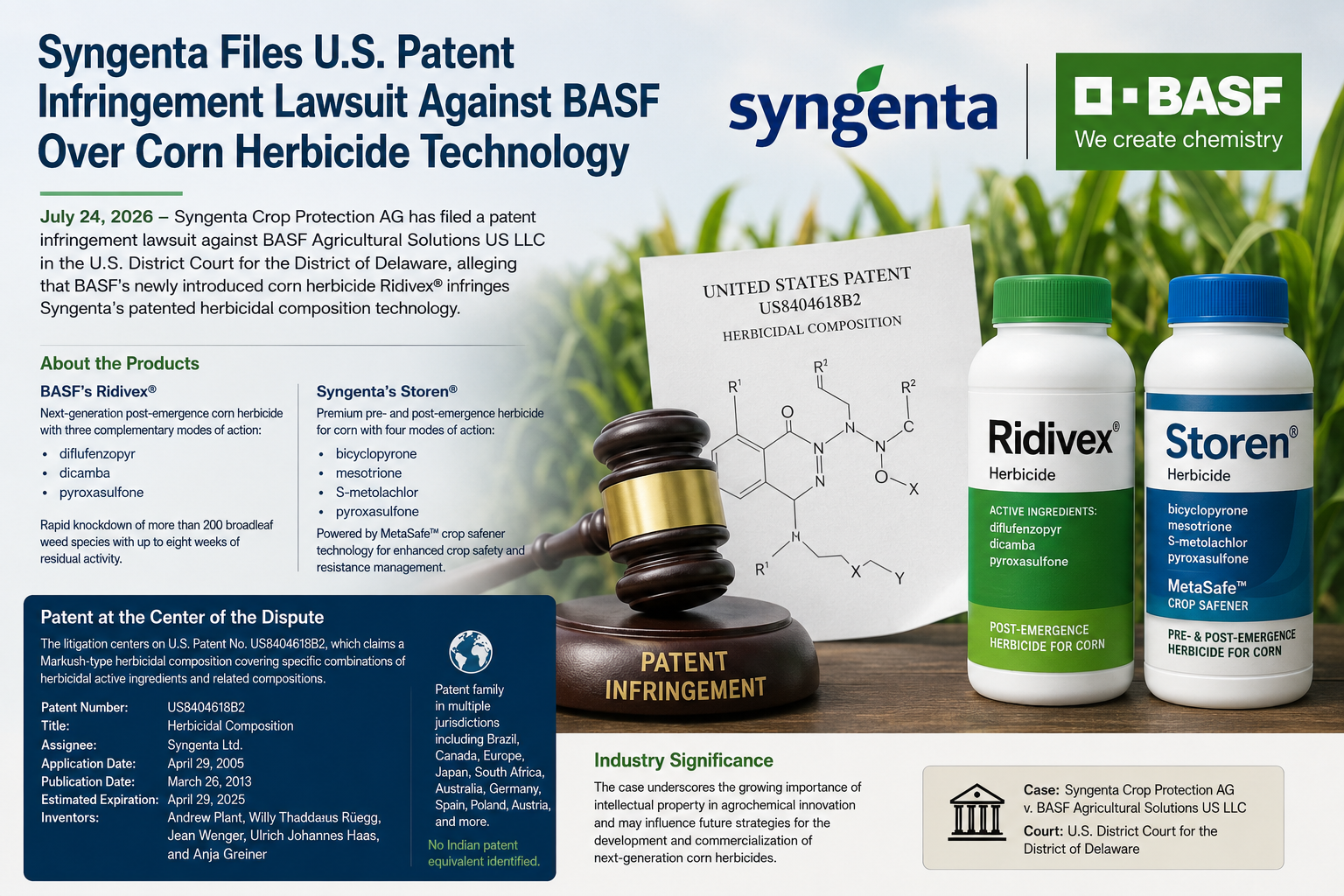
Syngenta Files U.S. Patent Infringement Lawsuit Against BASF Over Corn Herbicide Technology
July 24, 2026 – Syngenta Crop Protection AG has filed a patent infringement lawsuit against BASF Agricultural Solutions US LLC in the U.S. District Court for the District of Delaware, alleging that BASF's newly introduced corn herbicide Ridivex® infringes Syngenta's patented herbicidal composition technology. According to the complaint, BASF's Ridivex® product is alleged to infringe U.S. Patent No. US8404618B2, entitled "Herbicidal Composition." The lawsuit seeks judicial relief for the alleged unauthorized use of Syngenta's patented formulation technology and underscores the increasing importance of intellectual property protection within the agrochemical industry. BASF's Ridivex® Ridivex® is BASF's next-generation post-emergence corn herbicide developed to provide broad-spectrum weed control in corn production systems. The product is designed to deliver rapid knockdown of more than 200 broadleaf weed species while providing up to eight weeks of residual activity. The herbicide combines three complementary modes of action through the active ingredients diflufenzopyr, dicamba, and pyroxasulfone. The formulation also incorporates an integrated crop safener intended to enhance crop tolerance while improving control of herbicide-resistant weed populations. Syngenta's Storen® Syngenta's Storen® is a premium pre- and post-emergence herbicide for corn that provides season-long control of more than 70 difficult and herbicide-resistant weed species, including waterhemp (Amaranthus tuberculatus) and Palmer amaranth (Amaranthus palmeri). The formulation combines four herbicidal active ingredients—bicyclopyrone, mesotrione, S-metolachlor, and pyroxasulfone—together with Syngenta's proprietary MetaSafe™ crop safener technology, offering multiple modes of action for effective resistance management and enhanced crop safety. Patent at the Center of the Dispute The litigation centers on U.S. Patent No. US8404618B2, which claims a Markush-type herbicidal composition covering specific combinations of herbicidal active ingredients and related compositions.

FMC Files First Global Regulatory Submission for Herbicide Active Rimisoxafen with U.S. EPA
FMC Corporation has submitted the first global regulatory dossier for Rimisoxafen to the U.S. Environmental Protection Agency (EPA), marking a major milestone in the development of its next-generation herbicide technology. The submission covers use in corn, soybean, sunflower, and select pulse crops. Rimisoxafen is the first herbicide active ingredient classified by HRAC as a dual mode of action herbicide (Groups 12 and 32), targeting both phytoene desaturase (PDS) and solanesyl diphosphate synthase (SPS) to provide effective control of herbicide-resistant weeds, including Palmer amaranth and waterhemp. Following extensive research and field evaluations, FMC plans to expand regulatory submissions to additional global markets. The herbicide is currently under regulatory review and has not yet been approved for commercial sale or use.
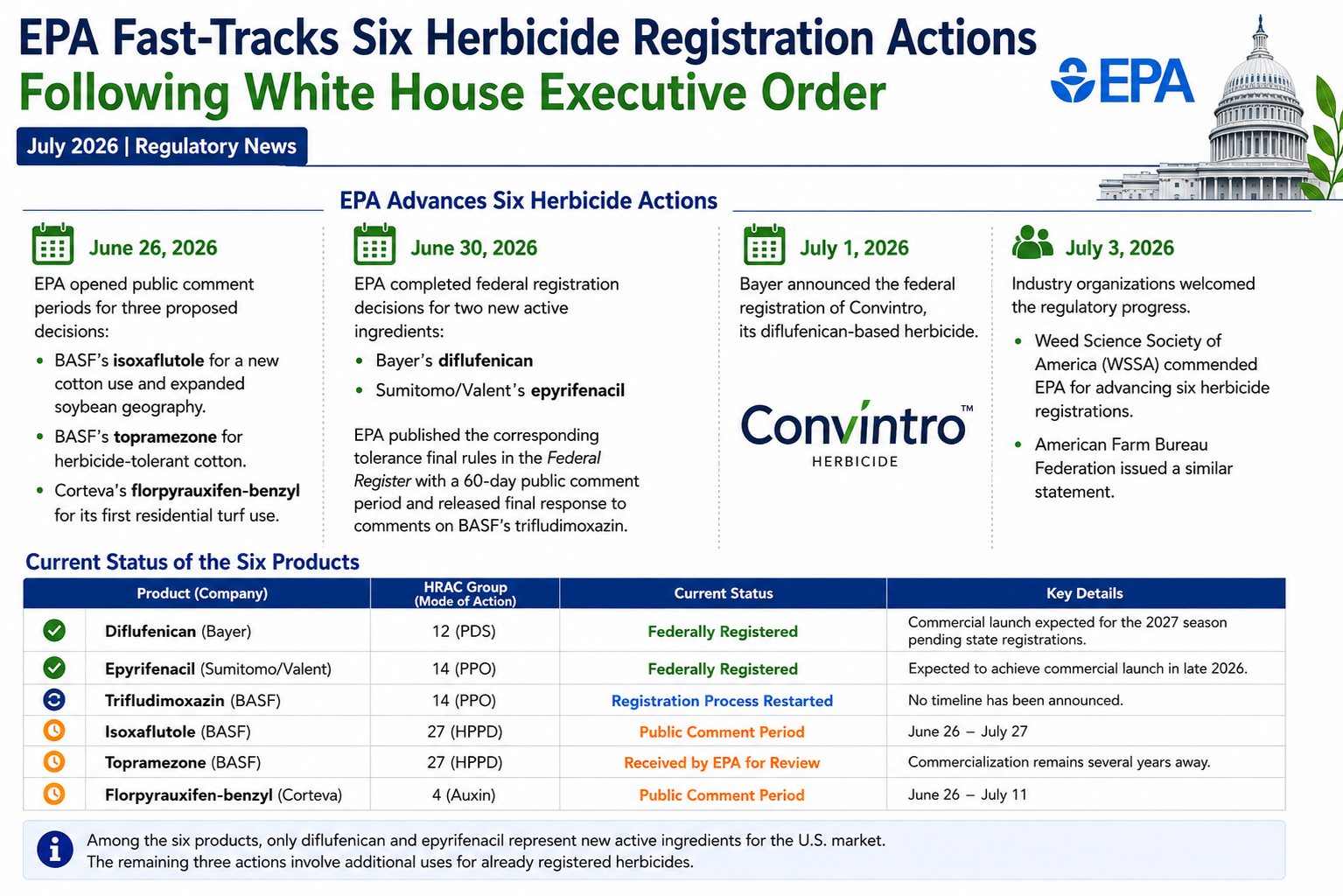
EPA Fast-Tracks Six Herbicide Registration Actions Following White House Executive Order
The U.S. Environmental Protection Agency (EPA) advanced six herbicide registration actions within a single week, marking one of the most active periods for herbicide regulatory decisions in recent years. The actions include federal registrations for diflufenican and epyrifenacil, public comment periods for three additional products, and the resumption of the registration process for trifludimoxazin. This article reviews the regulatory status of all six herbicides, examines their implications for crop protection and resistance management, highlights key regulatory considerations including PFAS classification and potential litigation, and explores what these developments could mean for the future commercialization of herbicide technologies in the U.S. market.

ChemRobotics™ Business, Scientific, & Innovation Intelligence for Generic and Discovery Agrochem, Pharmaceutical API & Specialty Chemical Industry including Battery Chemicals, Dyes, and LED Chemical etc.
Contact Us

ChemRobotics Private Limited SITE C UPSIDC SURAJPUR, GREATER NOIDA 201311, INDIA

+91 6266117944

support@chemrobotics.com
ChemRobotics Pvt. Ltd. © 2026, All Rights Reserved
Terms of Use and Privacy Policy
Follow us on


